
The Smith County Route From Address to Owner
Begin with the official Smith County Tax Search. Pick Real Estate. Type in the street number and name. Note the full CAMA or tax ID plus the legal description. Rural tracts often surface faster by section, township, and range. A parcel inside town may respond better to subdivision, block, and lot.
- Search the situs address and confirm that the result’s map location and legal description match the property.
- Read whether the displayed name is Current Owner, Taxpayer, or Both; do not erase that distinction.
- Take the legal description and name to the Smith County Register of Deeds and request the latest deed.
- Compare the grantee, recording date, prior reference, and property description with the parcel result.
- If an entity appears, use the Kansas business search only to understand the entity record, not to substitute an individual for the titled owner.
The method relies on two dated public sources. Unrecorded claims, estates, trusts, mineral interests, or competing legal descriptions may still call for a title professional.
Current Owner and Taxpayer Are Separate Smith County Fields
On the county form, a name search can target Current Owner, Taxpayer, or Both. The taxpayer is sometimes the owner. Sometimes it is simply whoever was designated. That person receives and pays the bill. Keep the role label from your result. Then compare it against the owner field on the Appraiser record.
| Field on the record | What it means |
|---|---|
| Current Owner | The ownership name carried on the present county roll |
| Taxpayer | The person or entity tied to the tax statement |
| Situs | The physical location used for the parcel |
| Mailing address | The destination for owner or tax correspondence |
| CAMA / tax ID | The appraisal or tax-system key used to retrieve the holding |
Owner of record names the party in the official roll or recorded instrument at a given time. A grantee is whoever receives an interest in a deed. Situs marks where the property sits, which is not always the owner's mailing address.
Confirm Who Owns the Property at the Register of Deeds
The Smith County Register of Deeds keeps deeds, mortgages, releases, liens, easements, plats, and similar instruments. The county publishes no online grantor-grantee portal. Confirmation therefore runs through the office at 218 South Grant, Suite 7, a call to 785-282-5160, email to smithcorod@gmail.com, or a written request. Give staff the owner spelling, the property description, and a rough recording window. Ask which instrument last conveyed the tract. Ask whether the index can be searched by grantee, grantor, legal description, book/page, or instrument number. A recorded deed names the grantee and states the interest it conveys. That document beats a name copied off a tax map every time.
Verification rule. The roll can lag a recent recording. Compare the roll’s update date with the newest deed’s recording date before naming a current owner.
What the Smith County Owner Search Actually Accepts
The tax form accepts far more than a surname. Options include street number and street name. Options also include a name with a chosen role, owner/taxpayer identification, tax ID, a segmented CAMA number, subdivision, block, lot, and section-township-range. The CAMA segments run MAP, SEC, SHT, QTR, BLK, PRE, SUF, and OWN. Copy the whole value, leading zeroes and suffixes included. A name alone invites error. Similar family names, farm entities, trusts, and estates can return matches that look right. Those matches may not be right at all. Narrow things with the situs, the legal description, the tax type, and the parcel key. The larger Smith County property search guide walks through the portal mechanics. But the ownership test stays the same: parcel match first, latest deed second. The Appraiser's public-records instructions confirm that real property files by parcel ID. The files can be located by owner, address, or parcel number. If a live card is not available, ask for the owner, situs, mailing, legal-description, and valuation fields on the exact parcel.
Four Official Clues to a Smith County Property Owner
Every source answers a different slice of the ownership question. Date each result. Keep the source name so any later discrepancy can be traced.
| Official source | Ownership clue | How to reach it |
|---|---|---|
| Appraiser / tax roll | Current-owner or taxpayer label, mailing and situs details | County public portals or Appraiser request |
| Register of Deeds | Grantee and conveyance terms on the latest recorded deed | Office, phone, email, or KORA request |
| Kansas ORKA | Spatial parcel context and identifiers where available | State GIS resource |
| Kansas Secretary of State | Business entity status and public entity details | Business Entity Search |
An occupant is not an ownership field. A mailing address might be a post-office box, a management office, a farm address, a trust, or an estate. A permit applicant could be a contractor or an agent. None of these stand in for the parcel-and-deed comparison.
Trusts, Estates, and LLC Names Need a Second Reading
The tax roll or deed may vest a tract in a trust, an estate, or an LLC. The owner of record may not be a person. Copy the entity name exactly as written. For an LLC or corporation, the Kansas Secretary of State search can verify the registered name. It can also confirm status. An agent or officer is not automatically the landowner, though. The titled entity stays the owner until another recorded instrument says otherwise. An estate may show up in the deed records. The Kansas District Court CaseSearch portal or the Smith County courthouse terminal may turn up a probate case. Court access and deed recording remain separate tracks. A probate order, an executor's deed, or a transfer-on-death deed may each be part of the trail. An affidavit may be part of it too. Vital records are restricted. Rely on the court and land instruments tied to the property instead of assuming open access to a death certificate. Repeated names pose another local hazard. Anchor the name to the legal description, the recording reference, and the parcel number. That combination keeps one family's land where it belongs. It stops a stranger with a similar name from being attached to the property.
Why a New Deed May Beat the Online Owner Label
Ownership rolls in a Kansas county change once a deed or similar instrument is recorded. Smith County publishes no fixed lag in days between filing and display. The tax portal and the Appraiser portal both carry update markers. Those markers describe system freshness. They do not date every conveyance.
After a closing, compare three dates. The deed's execution date comes first. Its recording date follows. Third comes the roll's public update marker. The newest recorded instrument can precede the owner label shown online. If the sources still conflict, ask the Appraiser whether the ownership transfer is pending. Ask the Register of Deeds to confirm the latest indexed instrument.
The official Appraiser access screen shows the county's Public Access route. It is a starting point for who owns a Smith County property. It is not a guarantee that the roll has caught every same-week filing.
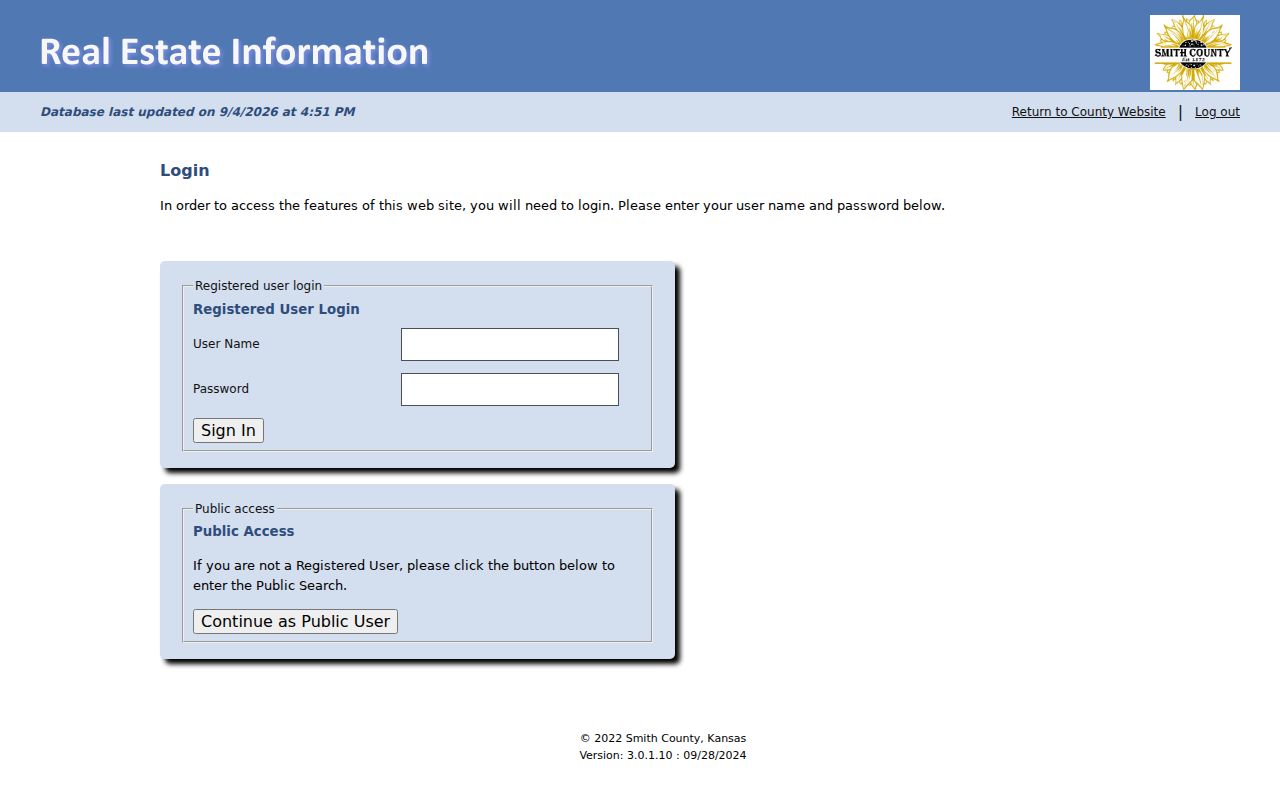
Note the portal's visible update information alongside the owner result. That marker tells any later reader exactly when the name was checked.
Protected Addresses Change What Ownership Records Display
Kansas Safe at Home protects addresses. The Attorney General administers the program for qualifying participants. It supplies a substitute address across voter, city and county, court, school, library, and other records. A protected or substitute mailing address is not proof that the owner name or parcel match is wrong.
Redactions and public-record exceptions matter too. Ask the custodian for the public portions of a defined property record rather than private material about a person. A Kansas Open Records Act request should identify the parcel, record type, dates, and custodian. The agency must respond by the third business day. Large or heavily redacted productions can take longer.
Smith County offers no property-fraud alert or deed-monitoring signup. Do not enroll through a similarly named service from another county. Owners worried about an unfamiliar filing should contact the Register of Deeds directly and preserve the instrument reference.
What a Smith County Ownership Lookup Cannot Prove
The owner of record is not always the occupant. The roll may also differ from the taxpayer, the permit applicant, or whoever receives mail at the situs. A tax or GIS result has further limits. It does not reveal every unrecorded interest, interpret the deed's legal effect, resolve a probate dispute, or certify marketable title. ORKA parcel lines offer reference context only and settle no fence or boundary dispute.
For roll freshness, turn to the current-owner guidance. Trace the backward chain with former-owner research, and use the deed records guide for instrument types and copies. That line keeps who-owns lookups distinct from title work.
Lawful use. A Smith County owner lookup supports purchase due diligence, estate research, boundary questions, deed-fraud review, and civic transparency. Never use public owner or address information to stalk, harass, intimidate, or harm anyone.