
A Practical Smith County Property Records Search
A street address, owner name, CAMA number, tax ID, or subdivision lot and block all work as entry points in the Smith County Tax Search. A section-township-range works too. The Appraiser also runs a Public Access portal. Write down what comes back. Save the full identifier, legal description, name role, tax year, and the update date the database displays.
Next, go to the office that owns the decisive record. The Register of Deeds holds recorded deeds, mortgages, liens, easements, and plats. The Treasurer handles statements and delinquency. The Kansas ORKA viewer supplies spatial context. No result from any of them substitutes for a title opinion, boundary survey, or present-day appraisal.
- Enter the situs address in Tax Search; if it fails, try the street name alone or an owner-name variant.
- Record the full CAMA or tax ID and legal description instead of relying on a name alone.
- Ask the Register of Deeds for the latest deed and use its grantee, grantor, recording date, and prior reference.
- Check tax status and value for the correct year and the Real Estate tax type.
- Use ORKA for location context, then order a certified record or survey when the question requires proof.
The Offices Behind Smith County Property Records
Smith Center serves as the county seat. The main custodians share the courthouse at 218 South Grant. Sort each request by record series before you go. The Register of Deeds keeps recorded instruments. The Appraiser keeps parcel and valuation files, and the Treasurer keeps tax statements and payment status. A focused request costs less. It also gets answered faster than asking one office to pull every record tied to a surname.
Smith County Register of Deeds
218 S. Grant, Suite #7
Smith Center, KS 66967
785-282-5160
Smith County Tax Search Has More Than an Address Box
The county form separates Real Estate from personal property, oil, gas, trucks, and minerals. It also splits out state-assessed utilities. Its name control can search Current Owner, Taxpayer, or Both. Those roles can differ. Preserve the label shown beside a name. Do not quietly treat every taxpayer as the owner of record.
| Search clue | Best control | Detail to retain |
|---|---|---|
| Street location | Street Number and Street Name | Situs address and full ID |
| Person or entity | Name plus role | Current Owner, Taxpayer, or Both |
| Town parcel | Subdivision, block, lot | Exact recorded spelling |
| Rural tract | Section, township, range | All legal-description elements |
| Known holding | CAMA or tax ID | Leading zeroes and suffixes |
The form also filters for statements with taxes due. That answers a tax-status question only; it does not surface every encumbrance recorded against the land.
The Appraiser Portal Opens the Parcel Trail
Real-property files, per the Smith County Appraiser, are organized by parcel identification number. They can be found by owner, address, or parcel ID. Public categories cover owner and mailing information, situs address, building characteristics, valuation history, agricultural use, and soil type. The categories also include aerial photography and parcel maps. A posted refresh date, though, proves little. It cannot confirm that a deed recorded today already appears on the roll. When the portal does not expose the needed card, the official Appraiser public-records page carries the guidance that matters. Most ordinary copies arrive same-day. Research-heavy or large computer requests take longer.
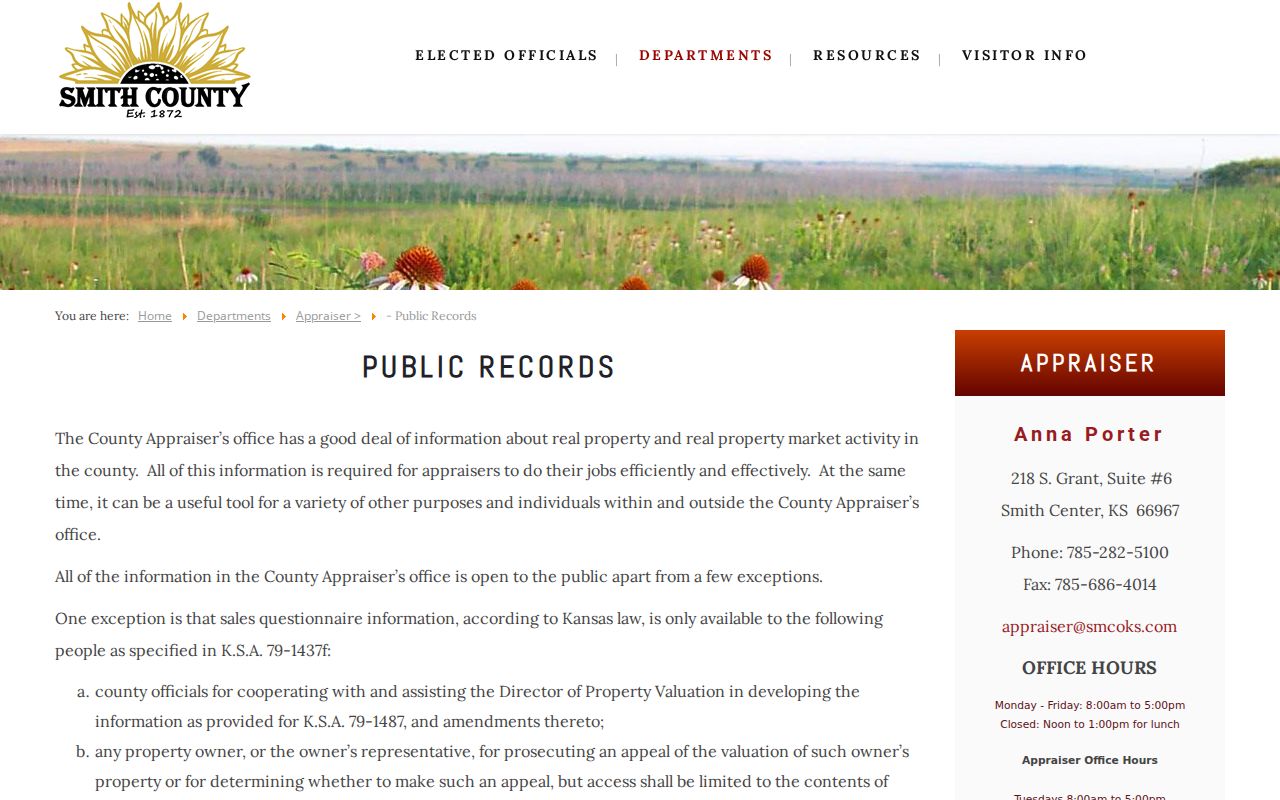
The Appraiser public-records page spells out the official request route. Use it rather than substituting a commercial owner database.
Which Smith County Property Record Answers Which Question?
Property files describe different parts of the same tract. Cross-reference them with the parcel ID and legal description, keeping dates and custodians attached to every note.
| Record set | Question it answers | Official keeper | Practical route |
|---|---|---|---|
| Deeds | Who received an interest, from whom, and when? | Register of Deeds | Office, phone, email, or focused KORA request |
| Mortgages and liens | What recorded claims affect the tract? | Register of Deeds | Instrument search at the office |
| Assessment | What characteristics and values are on the roll? | Appraiser | Public Access and records request |
| Tax | What statement and delinquency status apply? | Treasurer | County Tax Search or courthouse |
| Plats and parcel context | How is the tract described and mapped? | Register of Deeds / ORKA | Recorded plat plus spatial viewer |
| Municipal permits | What city work or street action was documented? | Relevant city clerk | Online forms or written request |
Turn to the dedicated Smith County deed records, property tax records, and parcel map guides for the details. The record sets overlap. None should be treated as a substitute for another.
No Public Smith County Deed Index Was Verified Online
The county Register of Deeds page says land documentation begins in 1872. Yet it offers no Smith County public grantor-grantee database online. That is an access fact, not an invitation to borrow an unrelated county portal. Start with the newest owner, the parcel ID, and the legal description. Then contact Stephanie Arment’s office at 785-282-5160 or smithcorod@gmail.com. Ask whether the internal index accepts grantor, grantee, book and page, instrument number, legal description, or parcel reference. Ask whether images can be viewed at the courthouse.
The official Register of Deeds page lays out this office-based route. Copies run $1 per page, and a certified instrument costs $13. Recording fees are separate. For older instruments, request an estimate. Identify each likely book, date range, and tract in advance.
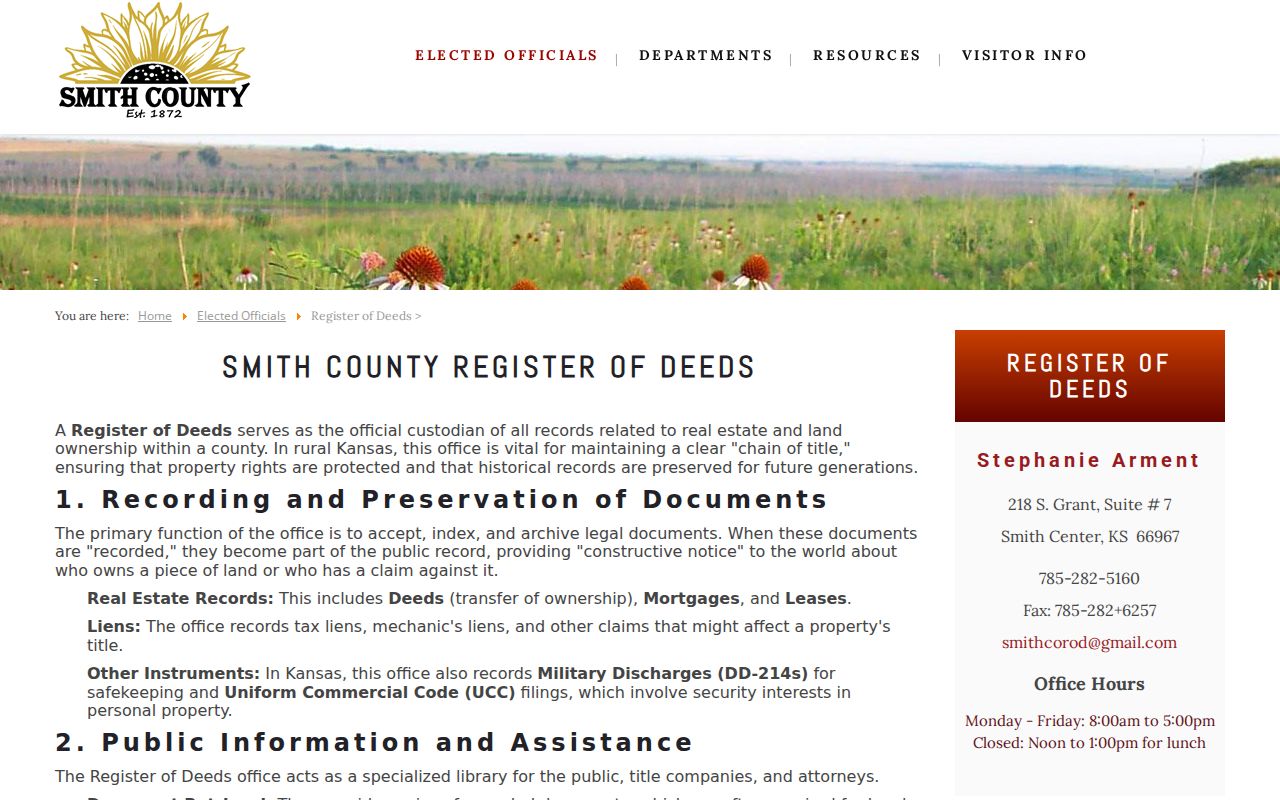
No online deed index exists for Smith County.
ORKA Adds Geography, Not Legal Certainty
The Kansas ORKA resource supports searches by address, owner name, Property ID, QuickRef ID, and map number. Its services describe parcels, roads, city limits, aerials, soils, water, flood context, school districts, and other layers. The county offers no Smith County-specific live viewer or adjacent-parcel tool, though. Treat Identify and Find results as reliable only when the live service makes the result clear.
Parcel map. A mapped tax polygon is a reference shape. A recorded legal description and licensed survey control a consequential boundary question.
Town parcels often rely on subdivision, block, and lot. Rural tracts instead turn on section, township, range, quarter-section, acreage, or metes-and-bounds calls. The segmented CAMA number should never be mistaken for the deed's legal description.
Smith County Values and Taxes Carry Different Dates
In Smith County, two offices split the work. The Appraiser sets classification and value. The Treasurer handles statements and payment status. Kansas residential property is generally assessed at 11.5 percent, though agricultural and other classes follow different rules. A sale price is only evidence, weighed against verified comparable sales rather than replacing appraised value.
The 2026 market-study notice reported a general upward trend for residential, commercial, and vacant categories. Individual parcels still differ. Check the parcel's own year, characteristics, land and improvement components, assessment class, and value history before judging any single tax bill. A countywide notice is not a Smith Center, Kensington, or Lebanon median.
Owners who dispute a valuation have a formal path. Follow the notice's appeal instructions and dates. The Appraiser FAQ explains valuation and appeal principles, and the Treasurer's protest route carries its own signature and payment requirements.
Historic Smith County Property Records Begin With Two Place Names
Smith County was established in 1867 and organized in 1872. Early years brought a county-seat fight. Cedarville was selected first. Kansas Historical Society accounts describe how the records were removed and Smith Center later prevailed. Search under both place names. For nineteenth-century land, probate, or county notices, confirm the township and legal description too, since an early "county seat" reference does not automatically mean a modern Smith Center address.
The 1900 Smith County plat book combines township landowner maps with a patrons' directory and town plats. It preserves vanished names too. Reamsville, Bellaire, Claudell, Cora, and Harlan appear in its pages. An atlas is a lead, not ownership proof. Carry any name from it into deeds, newspapers, census material, and later tax rolls.
| Year or period | Local records marker |
|---|---|
| 1867 | Smith County established |
| 1872 | County organized and stated start of Register of Deeds documentation |
| 1900 | Digitized landowner, directory, and town-plat book |
| 1918–1920 | Current courthouse construction period |
| August 2026 | Current tax and appraisal portal refresh markers observed |
City Files Explain Changes the County Parcel Card Cannot
Deeds, assessments, taxes, and parcel records remain county-held. Cities keep different files. Municipal offices produce permits, zoning decisions, minutes, and street actions that a county parcel card never captures. Smith Center posts $25 building and $10 fence permit forms, along with an ordinance index that includes street and alley vacations. Old plats can mislead. A plat may show a strip that no longer functions as a public alley, so compare the current parcel, the recorded plat or deed, and the city ordinance.
Kensington offers a clerk route at 101 South Main on weekday mornings but publishes no online permit or zoning index. Lebanon's clerk office sits at 404 Main. Hours run Monday through Thursday afternoons. No official municipal property portal exists. The city pages for Smith Center, Kensington, and Lebanon preserve those different access patterns.
When Online Smith County Records Stop Short
A dead portal does not end the search. Smith County still answers by phone, email, and mail. Visit or call the courthouse, email the proper custodian, or submit the county's written inspection-and-copy form. The Kansas Open Records Act, K.S.A. 45-215 et seq., sets the clock. An agency must act as soon as possible and by the end of the third business day. For a large or redacted file, that response may set a later production date.
Fees are published. Smith County charges $0.25 per letter or legal page and $0.50 for oversize pages, with staff research or preparation at $20 per hour or a higher actual employee rate. A precise request saves money. Give record titles, dates, department, property keys, and the copy format you want. Ask which office is the legal custodian, whether the requested portion is public, what search or redaction time may cost, and whether an electronic, plain, or certified copy is available. Older leads can run through Kansas Historical Society collections. Smith Center Public Library also answers focused holdings questions.
Preparation pays at the courthouse. Bring the situs address, owner and taxpayer spellings, the full CAMA or tax ID, the legal description, and known recording dates. Keep separate notes for each office. The Register of Deeds, Appraiser, Treasurer, County Clerk, and District Court Clerk each answer a different question. Log each response date and quoted fee. An offline result stays traceable that way.
Liens, Court Cases, and Delinquent Taxes Follow Separate Trails
A deed search alone misses plenty. Beyond deeds, the Register of Deeds records mortgages, assignments, releases, mechanic's liens, tax liens, lis pendens, easements, rights-of-way, and UCC fixture filings. Search the obligation and its release together. An old lien reference without the closing instrument paints a misleading picture.
Court disputes follow a second trail. Foreclosure, quiet-title, partition, probate, and lien-enforcement cases belong to the District Court record. Smith County sits in Kansas's 17th Judicial District. The Kansas CaseSearch portal may require an account, a name or case number, and optional filters. Some case types and documents stay restricted. The county's eCourt transition date is not published. For a docket or copy that is not online, the courthouse terminal and the District Court Clerk at 218 South Grant remain the fallback.
Delinquent tax is a third trail. The county Tax Search can limit results to statements with current or delinquent amounts due. Confirm the result is Real Estate. Save the tax year and parcel key, then ask the Treasurer about payment status, publications, or tax-foreclosure procedure. A delinquent statement, a filed tax lien, and a court foreclosure case are related records, not interchangeable stages.
Cross-check. For a consequential claim, keep at least two independent keys-parcel or CAMA ID plus legal description or recording reference-and date every source.
Assessment Appeals Need the Parcel’s Own Evidence
The Smith County Appraiser revalues every parcel each year. It draws on property characteristics, classification, verified sales, and accepted valuation approaches. Kansas guidance also splits appraised market value from assessed value. The assessed figure applies the statutory percentage set for each property class, and the resulting taxable value then meets mill levies and other charges to produce the tax amount.
An appeal works best when it leans on the parcel's own evidence. Start with the valuation notice. Pull the parcel card too. Add the land and improvement breakdown, the property class, and any factual errors in size, use, condition, or building characteristics, since those details drive the numbers. Photos help when they show the disputed feature.
The county's overall 2026 market direction does not settle one parcel. Corrections, changes, location, and specific market evidence can move a result. Trust the notice, not an old calendar. Kansas materials describe a 30-day window to contact the Appraiser after a valuation notice, plus separate payment-under-protest routes whose dates depend on how taxes are paid. For Treasurer payment and delinquency questions, the Smith County property tax guide keeps those apart from valuation appeals.
The Limits Around Smith County Property Records
A deed names a grantee. The tax roll names an owner of record. Smith County property records carry real weight, but only within their limits. A parcel number ties a tract to its plat and GIS map, and the assessor's appraisal explains the tax bill. What the paper trail cannot do is confirm who actually lives there, prove that every lien or interest reached the recorder, or turn a tax line into a surveyed boundary. An assessed value, likewise, is not a sale price. Read each record for what it is, not for what it is not.
Lawful use. Use Smith County property records for ownership verification, purchase research, estate work, boundary questions, tax appeals, house history, and civic transparency. A records search does not replace a title company or licensed surveyor, and public names or addresses must never be used to stalk, harass, or harm anyone.