
Trace Smith County Former Owners
To trace former owners of a Smith County parcel, work backward from the newest deed. Start with the current owner of record and today's legal description. Then add one row per transfer as each earlier deed comes to light. The county publishes no online deed index. A public web search alone cannot finish the chain. Treat the project as an ongoing research worksheet rather than a completed link.
| Transfer Date | Grantor to Grantee | Deed Type | Book/Page |
|---|---|---|---|
| Newest recording | Latest grantor to present grantee | Copy exact label | Current citation |
| Prior recording | Prior grantee to latest grantor | Copy exact label | Cited prior reference |
| Earlier recording | Repeat for the same land | Copy exact label | Office or deed-book citation |
Record every entry with care. Log the date, the parties, the deed type, and the exact book and page citation, and keep the legal description beside the table the whole way. A name alone cannot establish an earlier owner. Every date gap should carry a note naming the office, book, archive, or map where you searched, so an unresolved link stays visible instead of hardening into an unsupported claim.
Smith County Former Owners Since 1872
The Smith County Register of Deeds dates its documentation to 1872. That starting year does not guarantee a complete run for every series. It does not promise a digitized collection or any online cutoff. The county offers no public grantor-grantee portal. A property search for previous owners therefore begins with the parcel or tax roll lead. From there it moves into the office's alphabetical listings. It also draws on the legal-description indexes and the deed books themselves.
Online access is not confirmed. Smith County documentation starts in 1872, but deed-index and image coverage remain unverified.
The Register of Deeds sits at 218 S. Grant, Suite 7, in Smith Center. Reach the office by phone at 785-282-5160 or by email at smithcorod@gmail.com. Ask staff which index covers your target years. Ask whether a cited volume is onsite or archived. Also ask whether they can search a precise legal description. Access runs through a visit, a call, email, fax, or a focused written KORA request.
Smith County Former-Owner Recording Clues
Every Smith County deed index entry rests on a handful of core clues. Book and page come first. The instrument number, recording date, party names, document type, and legal description follow. When a new deed cites a prior instrument, chase that citation. Do that instead of running a broad name search through the property records. Town land calls for the addition, block, lot, and plat name. Rural land calls for section, township, range, quarter call, and acreage.
- Grantor
- The party conveying the interest.
- Grantee
- The party receiving the interest.
- Chain of title
- The linked sequence of recorded transfers for the same land.
- Reverse index
- An index used to follow names back through prior acquisitions.
- Warranty deed
- A conveyance with title promises stated in the instrument.
- Quitclaim deed
- A conveyance of the interest held, without the same promises.
The label on a deed is only the start. Read what land and what interest the instrument actually conveys. A single deed may carve one tract out of a larger holding, and a later split or replat can fork the ownership timeline into separate parcel chains within the Smith County property records.
Smith County Names That Repeat
Names in older Smith County deed records rarely stay consistent. Indexes shorten them to initials. Trusts, estates, farms, and entities multiply the possible forms. Confirm each candidate party with the same tract description and recording references. A shared surname is not enough. Neither is a shared town. Historic place names matter just as much. Cedarville, Reamsville, Bellaire, Claudell, Cora, and Harlan all appear in the 1900 atlas. An old deed or published notice may carry one of those names where a modern parcel bears only a township or ZIP label. Keep both versions in play during any property search.
Estate Transfers Among Smith County Prior Owners
Estates can break a clean sale-to-sale chain of title. An executor, administrator, estate, or trust may appear as the grantor instead of a familiar owner of record. Check the instrument type and the stated authority. A probate docket can list parties, filings, and orders, but the recorded deed in the Smith County deed records remains the land-record link. Smith County sits in the 17th Judicial District. Kansas CaseSearch and the courthouse terminal both offer access, though not every case or document is online. Keep case numbers and deed citations as separate references. Search the decedent, the estate, the representative, and any successor names, then match each order or deed to the parcel's legal description.
Read Smith County's Chain Backward
Work backward from the most recent deed you hold. The current owner of record acquired the parcel through a recorded instrument, and that deed names the grantor who sold it. Track each grantor to the prior deed, confirming that every instrument describes the same land. The chain holds only while the descriptions match.
- Capture the current name, CAMA number, and full legal description.
- Find the newest deed and note its grantor, grantee, date, and citation.
- Find that grantor's earlier acquisition as grantee and confirm the same land.
- Repeat through office indexes and books, marking any gap rather than guessing.
- Grantor / grantee
- The conveying and receiving parties.
- Chain of title
- The ordered series of past recorded transfers.
- Legal description
- The land key that survives street and mailing changes.
Atlas Snapshots of Smith County Past Owners
The 1900 Smith County plat book joins township landowners, a patrons' directory, and town plats. KSHS also catalogs a circa 1917 atlas, while the county genealogy page cites a 1928 map.
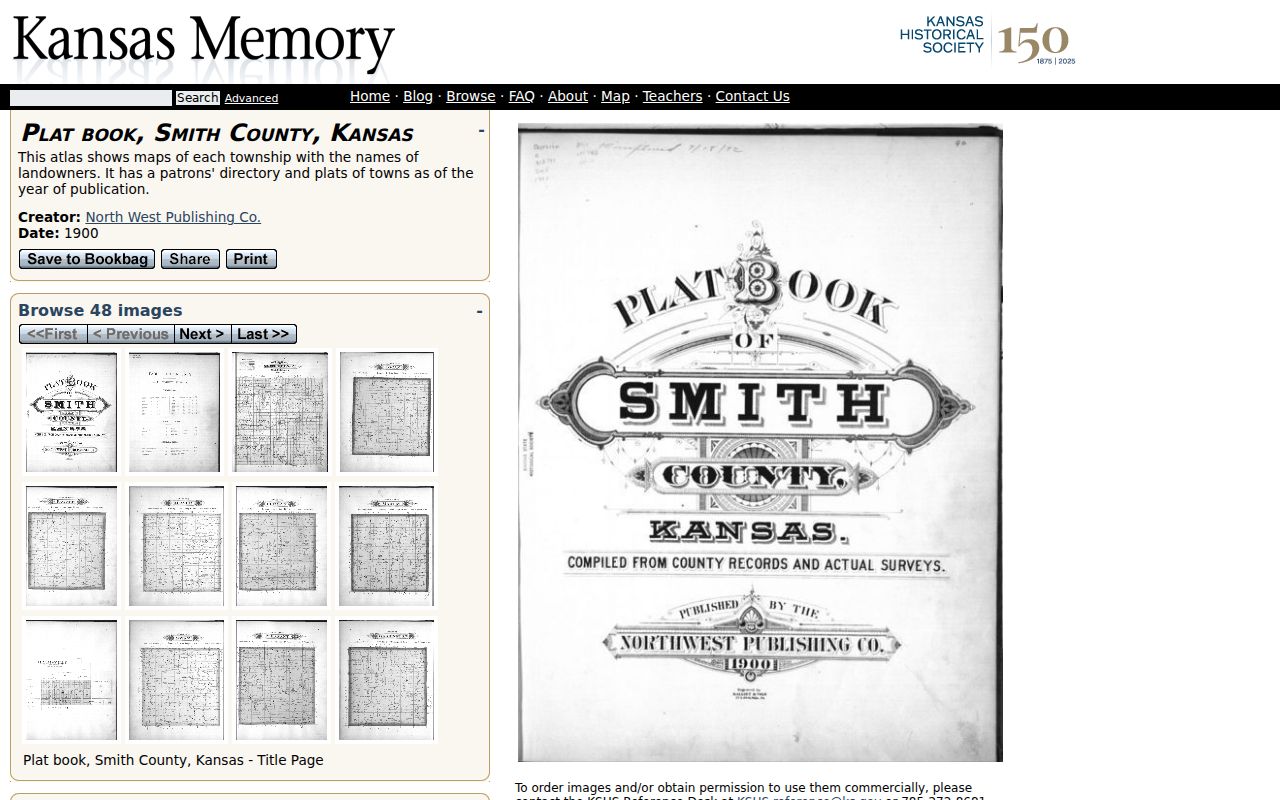
The Kansas Memory catalog page lays out the atlas collection. It also covers town and township coverage. Treat any atlas owner as a snapshot rather than a recorded transfer. That matters. Use the plat to pinpoint a township, section, town plat, or name variant. Then head back to the deed records for proof of conveyance. Owners inside a town may not be listed lot by lot.
Cedarville in Smith County Ownership Records
Cedarville offers a useful historic search key. The 1872 county-seat contest pitted Cedarville against Smith Center. Old notices from that era may cite Cedarville, even though the courthouse now sits in Smith Center. When the date and geography line up, search both names.
KSHS newspapers can fill in the story around a transfer. Estate notices, sheriff's sale notices, tax notices, and ordinances all surface in the database. The database searches by city, title word, county, and date range. Some film can be requested through a library. These items explain events surrounding a transfer, but they never replace the recorded instrument itself. Smith County deed books survived intact. No courthouse fire or wholesale loss of records complicates the chain.
Offline Routes to Smith County Previous Owners
Start with the recorder. The Smith County Register of Deeds keeps every deed book. A prior transfer that is not online still lives on those shelves. Bring the current legal description, CAMA or tax ID, likely party names, and a useful date range. Ask which alphabetical and legal-description indexes cover the period. Ask whether the deed book is onsite. Ask how a cited volume can be inspected. A narrow question helps staff. It separates the right tract from other land held by the same family or farm.
The county's genealogy guide maps the wider paper trail. It identifies deeds, mortgages, miscellaneous records, atlas maps, school-district files, cemetery books, and federal patent research. Each collection plays a different evidentiary role. Mortgage releases and liens can sit between conveyances without adding a former owner. School or cemetery records may support identity and residence. Yet they remain outside the title chain.
If an office visit is not possible, call or email the recorder with a focused request. A county record-inspection form under KORA offers another route. State Archives county microfilm and land-record guides are the next stop for older material. Smith Center Public Library may help identify local newspapers, directories, telephone books, yearbooks, or obituary files. Exact holdings are not posted in the official source, so ask before assuming a run exists.
Note: Keep office, archive, atlas, and newspaper findings in separate source columns so a clue is never mistaken for a recorded transfer.
How Far Smith County Former Owners Go
Older sources demand care. Preserve every original name spelling and record date when you extend a chain.
The local record reaches to 1872. Earlier federal transfers may appear in tract books and patent sources organized by legal description. KSHS notes that tract books can list a purchaser or grantee, acreage, sale date, price. Governing law can appear there too. They are not indexed by owner name, though. The county chain may hit its first deed. Carry section, township, and range into the federal land sources. County books, KSHS microfilm, atlases, and newspapers form the fallback chain. A missing online result means one thing only.
Lawful use. Research prior owners for land history, title work, estate questions, or property diligence. Never use records to track or harass a living person.