
Smith County Current Owner Record
Smith County's Tax Search prints the role label exactly as "Current Owner" and keeps it apart from "Taxpayer." Take the name letter for letter, including trust wording, estate labels, LLC suffixes, and any "et al." Then tie that name to the parcel keys and both addresses. A name alone proves little. Families, farms, estates, and entities often share nearly identical text across the property records.
| Owner of Record | The person, trust, estate, joint owners, or entity on the roll |
|---|---|
| Taxpayer | The party tied to the tax account, which may differ |
| Mailing Address | Where owner or tax correspondence goes |
| Situs Address | The physical location of the property |
| Parcel Keys | CAMA number, tax ID, and complete legal description |
| Record Dates | The tax year, portal update marker, and deed date when found |
Situs and mailing fields serve different purposes. Neither one shows who actually lives there. A permit applicant, utility customer, or directory listing can name someone other than the titleholder of record.
Check Smith County Owner Roles
When a first search comes back murky, run it twice. Pick Current Owner for the roll's ownership label, then Taxpayer for the account role. Line up both results by CAMA number, tax ID, situs, mailing address, and legal description. A broad name search gets sharper when you test initials and punctuation. Try trust wording too. Entity suffixes help as well.
A Kansas Secretary of State business filing may reveal an entity or resident agent. It still does not prove who owns the parcel. The county tax roll and the latest deed remain the controlling property records. Keep every conclusion inside what its source actually states.
The mailing address adds a cross-check without redefining the owner field. An absentee owner may get tax bills far outside Smith County. A farm entity may list a post-office box. An estate may route notices to a representative. None of that makes the mailing recipient an occupant. Keep the portal's labels just as given. Then compare the same CAMA number and legal description across each result. That habit pays off when a surname sits on several holdings. It helps when one owner holds both real-estate and other tax accounts, too.
When Smith County Rolls Change
County clerks follow the Kansas County Clerk Handbook. They move assessment and tax rolls to a new owner of record once a deed or similar instrument is recorded. That rule says nothing about display timing. Smith County publishes no standard number of days for an ownership refresh. The annual value-notice cycle is a separate event from a parcel owner update.
A recent sale may be involved. Save three things: the deed's recording date, the portal's database date, and the roll's tax year. System dates describe the systems themselves. They do not guarantee that every new deed has reached the public roll. The county's Public Access portal is the official online starting point for the current roll.
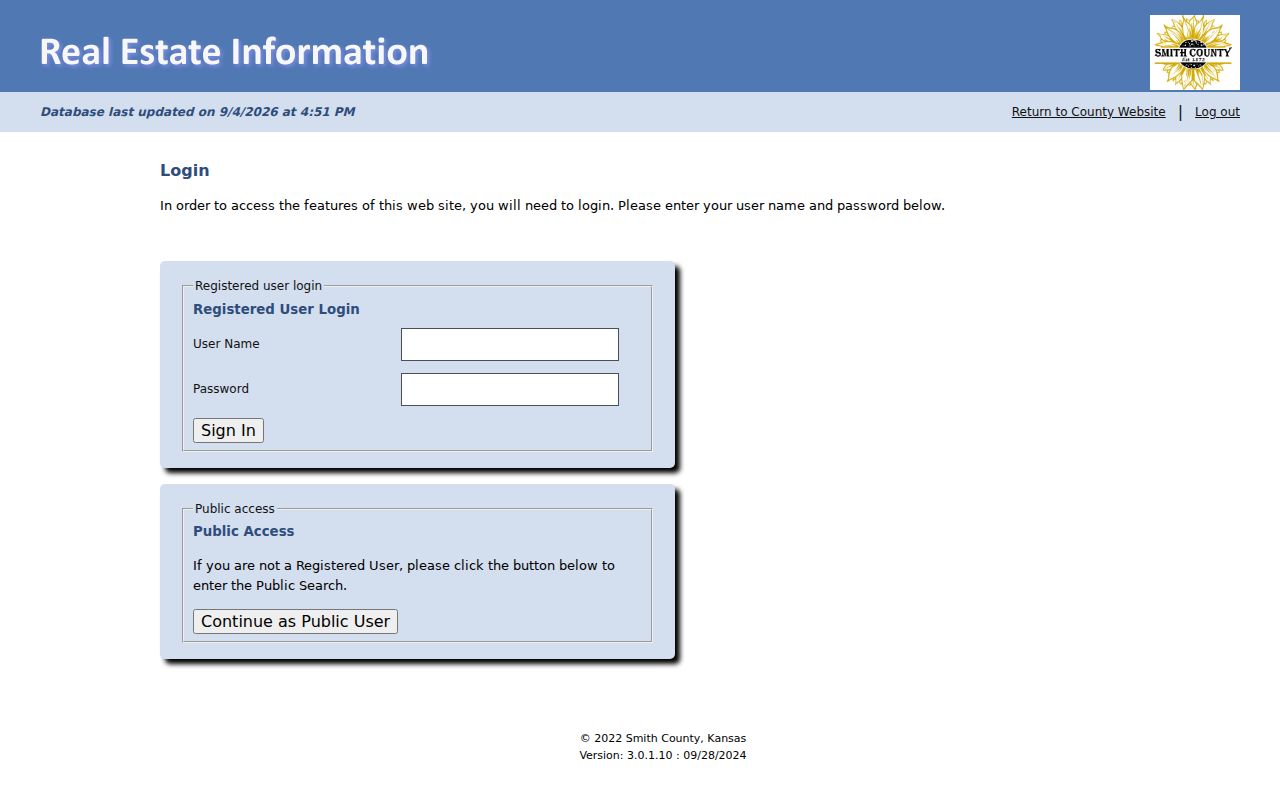
The Public Access login page opens the official county route to the roll. Its displayed date still deserves a comparison with the newest deed recording date before you treat the owner of record as final.
Note: A newly recorded deed can precede the public owner display, so check both records before relying on a recent change.
Smith County Owner Name Pitfalls
A current owner may appear as a person or as joint owners. It may also appear as a trust, an estate, or a business entity. Copy every punctuation mark and suffix. Search Current Owner and Taxpayer separately. Use mailing address, situs, parcel number, and legal description to separate same-name results.
An estate label may point toward probate records, but a docket never replaces a deed. A trust can hide the people behind it. An LLC filing may name a resident agent who owns no land at all. These distinctions keep an owner check honest.
When an estate shows up, search the Kansas court portal for the decedent, the personal representative, or a related probate case. Treat what you find as a lead. The District Court may hold an order or estate file. The Register of Deeds holds the instrument that actually changed the land record. A transfer-on-death deed, survivorship document, executor's deed, administrator's deed, affidavit, or deed of distribution may explain the current roll. Only the exact legal description and recording date tie that document to the parcel.
Protected Smith County Addresses
Kansas Safe at Home gives eligible participants a substitute address across voter, court, city, county, school, library, and other records. A substitute or withheld address in the parcel data is not a search error. Nor is it proof that the record itself is false.
Respect protected information. Use owner records for lawful property diligence. Do not try to defeat an address-confidentiality measure or use records to harass anyone.
Program questions go to the Kansas Attorney General's Safe at Home office. Parcel-field questions go to the county custodian.
Confirm Smith County's Current Owner
Whenever timing or legal certainty matters, check the current owner of record against the newest recorded deed. Start at the Smith County Tax Search. Save the CAMA number and the complete legal description, because the county publishes no online grantor-grantee index for public use.
- Search the situs and copy the exact Current Owner label.
- Record CAMA, tax ID, mailing address, situs, and full legal description.
- Ask the Register of Deeds for the latest instrument tied to that land and read the grantee.
- Compare recording date, roll year, and portal update marker before resolving a mismatch.
- Owner of record
- The party named as owner on the current county roll.
- Vesting
- The wording that states how title is held, such as jointly, in trust, or by an entity.
- Registered agent
- A contact named in a business filing, not proof of ownership.
Latest Smith County Instrument
Deeds, mortgages, releases, liens, plats, easements, and UCC filings all live with the Smith County Register of Deeds. Recordkeeping in the county dates to 1872. There is no online Smith-specific deed index. So the newest deed search runs through the office itself. Call 785-282-5160, email smithcorod@gmail.com, or stop by 218 S. Grant, Suite 7 in Smith Center.
Give the staff the exact grantee name, the legal description, a parcel reference, and a date range. Ask for the recording date, document number, book and page. Also ask for document type and both grantor and grantee. Copies run $1 per page. A certified instrument costs $13.
Read the vesting language on the instrument itself. An index entry may shorten a name or simply point the way to the recorded image. Confirm the land description matches the appraisal result. Check that every named grantee appears, and whether a corrective deed, affidavit, or estate instrument was recorded later. Mortgages, releases, liens, and easements can name the same party without conveying anything. So the newest item under a name is not always the newest ownership document in the property records.
Resolve Smith County Roll Questions
A mismatch in Smith County property records is often not an error. It may reflect a recent recording or a different taxpayer role. It could also be a name variant. Or it may be a simple tax-year difference. Hand the Appraiser the parcel ID and name the exact fields in question. The county files real property by parcel ID. Records can be pulled by owner, address, or parcel number.
A Kansas Open Records Act request should name the record, the office, and the date range. It should also ask for an estimate. The agency must act by the close of the third business day. Larger or redacted files can take longer.
Split requests by custodian. Ask the Register of Deeds to confirm the latest recorded conveyance. Take the roll entry to the Appraiser or Clerk. Include the CAMA or tax ID and the full legal description. Add the owner label exactly as displayed and the deed recording reference. Include both dates being compared. Only after the two records match the same land should you request a correction procedure. A protected address or redaction may apply. Ask which public field can be confirmed rather than chasing the withheld detail.
Reach a Smith County Property Owner
The mailing address on the public tax roll is the most direct official contact clue. Address a neutral letter to the exact owner of record as shown. Reference the parcel. State your property-related reason for writing. Never assume the owner lives at the situs. Do not publish a protected address.
A current-owner lookup is not a title opinion. It cannot establish occupancy. It cannot settle authority for a trust or estate. It cannot reveal unrecorded claims against the deed. For a purchase, an easement, or any high-stakes matter, rely on the latest deed and qualified title or legal help.
Lawful use. Public owner details may support property diligence and civil contact. Never use them to stalk, harass, intimidate, or harm any person.