
Smith County Deed Records
Deed records in Smith County are the Register of Deeds' core business. Each deed names a grantor and a grantee. It also describes the parcel. It spells out what interest changed hands. Recording a deed makes the transfer part of the public record. The same office also files mortgages, liens, releases, easements, plats, and UCC fixture filings. Those instruments do different work than a deed does. Check the document type before assuming an indexed name is the owner of record.
| Deed Type | What It Does | Common Use |
|---|---|---|
| Warranty deed | Conveys the stated interest with title covenants. | An arms-length transfer. |
| Quitclaim deed | Conveys whatever interest the grantor has without the same covenants. | Family or title-cleanup transfer. |
| Executor or administrator deed | Conveys under estate authority. | A probate-related transfer. |
| Tax deed | Conveys after the statutory tax process. | A delinquent-tax transfer. |
| Plat or easement | Creates map context or a limited land right. | Subdivision, access, or utility issues. |
A mortgage or lien encumbers land. It is not a deed. Track it forward for any assignment, release, satisfaction, or termination, because an entry that looks open may have a later instrument that closed it.
Smith County Deeds Start Offline
Smith County publishes no public grantor-grantee portal or online image viewer. Deed records start offline, at the Register of Deeds office. Ask staff which internal index covers grantor, grantee, instrument number, book and page, legal description, or parcel reference, and whether document images can be viewed at the counter.
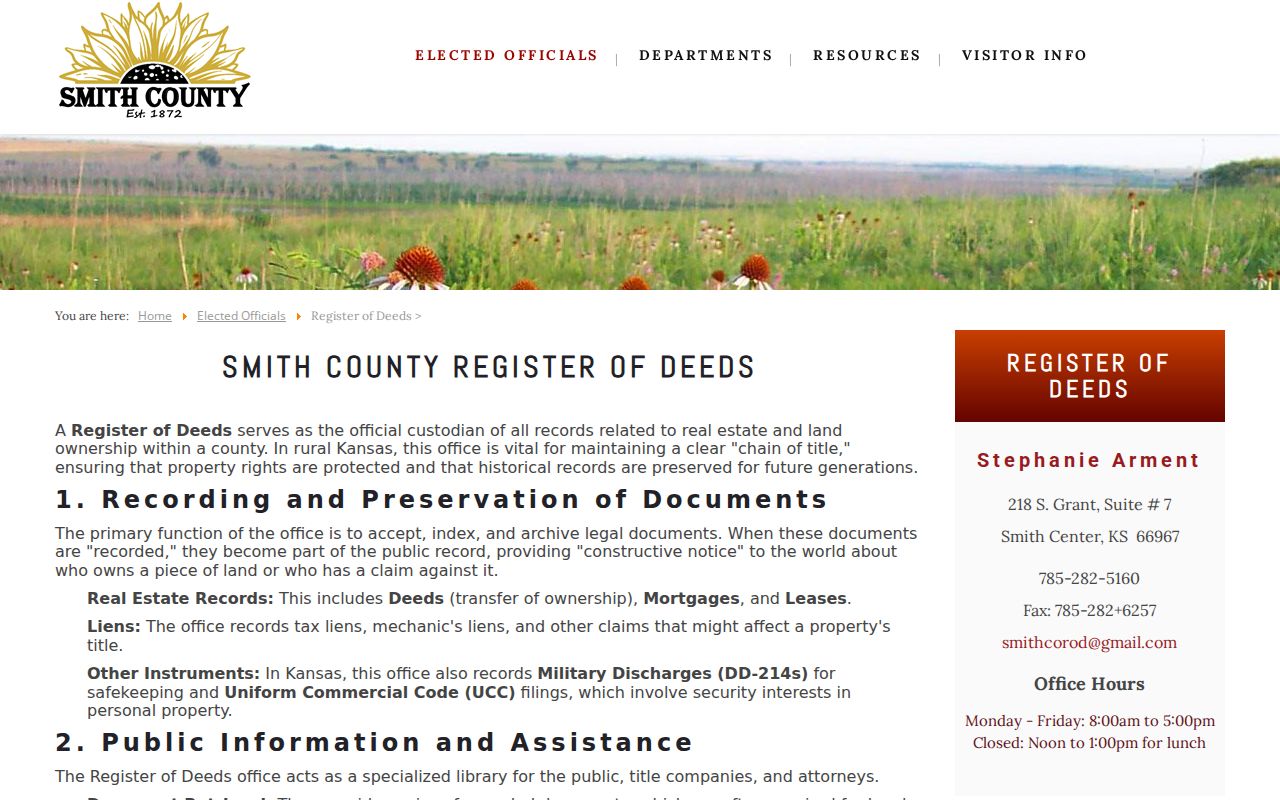
The Register of Deeds page names the officeholder and contact routes. It offers no online deed search. The office lists Stephanie Arment at 218 S. Grant, Suite 7, Smith Center, KS 66967, reachable at 785-282-5160 and smithcorod@gmail.com. Hours run weekdays from 8 a.m. to 5 p.m., closing noon to 1 p.m. Those direct channels matter. A missing web result says nothing about the county books.
Smith County Recording References
Bring the exact current owner name, any prior owner, the complete legal description, and a date range. Add the CAMA or tax ID as a cross-reference. For a town parcel, keep the addition, block, lot, and plat name intact; for rural land, keep section, township, range, quarter, and acreage.
| Grantor / grantee | Expected office index keys; exact public web fields are not posted. |
|---|---|
| Book / page | A historic recording citation that can jump to a named volume. |
| Instrument number | A document-level recording reference. |
| Legal description | The durable land key when names repeat. |
| Date and type | Tools for narrowing deeds, liens, releases, plats, and related records. |
The county's own page says research can use alphabetical and legal-description listings. Confirm index labels and year spans with staff. Ask staff to report the indexed spelling, not just a normalized name. Farms, trusts, estates, joint owners, and business entities can shift wording between instruments. When a deed cites a prior book and page or instrument number, follow that reference. Do this before falling back on a broad surname search. That reference usually anchors the chain of title. It also prevents a false match to another Smith County tract. A legal description should stay recognizable across transfers. But a split, combination, replat, exception, or easement can alter its wording. Copy the description from each deed and note every change. A CAMA number helps staff locate the modern holding. Yet it is not a recording citation, and it should never replace the deed's own reference.
Smith County Deed Fees
Smith County's official fee schedule splits recording fees from copy and research charges. Recording a deed or mortgage costs $21 for the first page. Each added page is $17. Plain copies run $1 per page. A certified instrument is $13, and an acknowledgment runs $12.50.
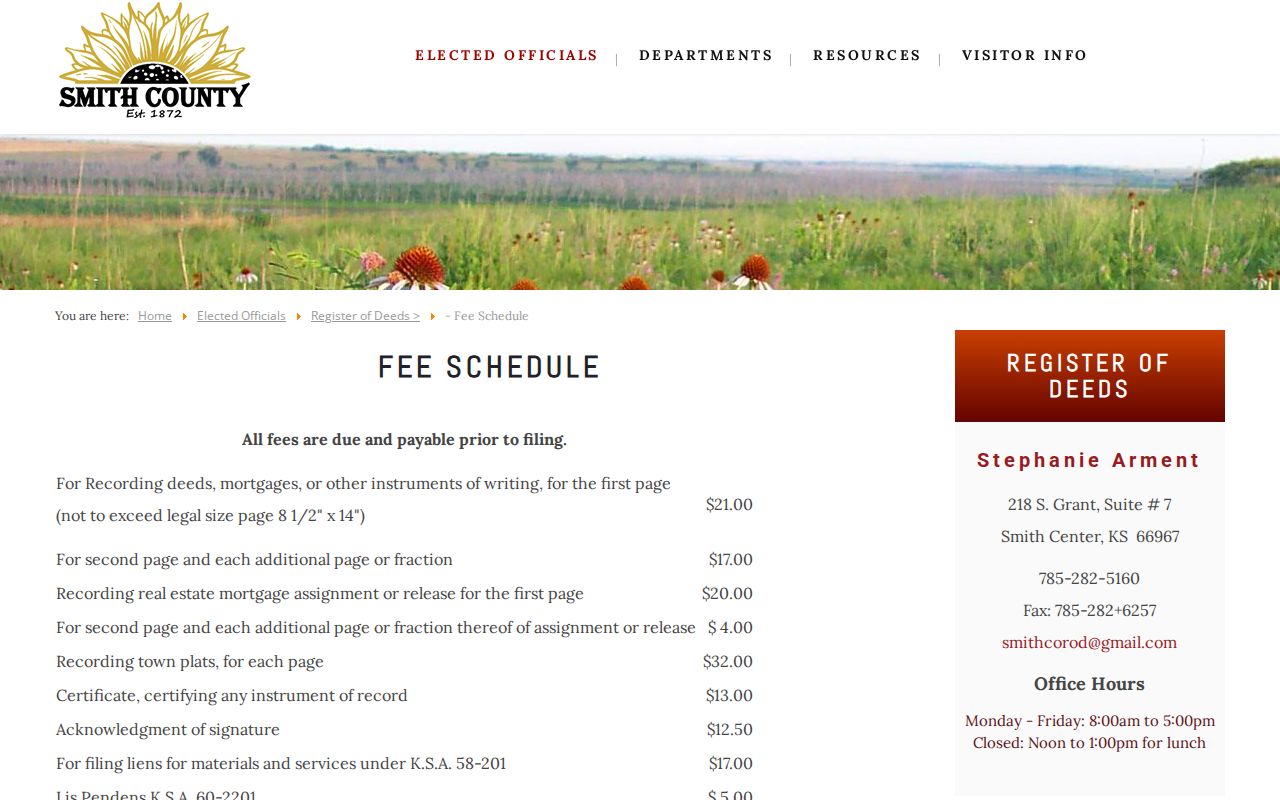
The posted schedule distinguishes two prices. One covers a copy. The other covers recording a new instrument. Mortgage assignments and releases cost $20 for the first page and $4 per added page. Town plats are $32 per page. Materials or services liens run $17, and lis pendens filings $5. Broad open-record research may carry staff-time charges, so ask for a written estimate first.
Deed Validation in Smith County
Deeds and affidavits declaring an equitable interest generally require the Kansas Real Estate Sales Validation Questionnaire. A stated exemption can replace the questionnaire. The fee schedule also describes a cap for a qualifying single-family principal-residence mortgage of $75,000 or less. The cap applies when the required affidavit is supplied. These are recording rules only. They do not prove a conveyance carries clear title. Ask the recorder which form or exemption notation fits the instrument at hand. Do not copy an assumption from another Kansas county.
Smith County Grantor-Grantee Chain
A grantor-grantee index arranges people and entities by the instruments they signed. Trace ownership from the latest deed back, one transfer at a time. Hold the legal description steady while the names change. That discipline keeps you from joining two same-name parties. It also prevents mixing up nearby tracts.
- Find the present owner's acquiring deed, where that owner appears as grantee.
- Read the grantor and every cited prior recording reference.
- Search that grantor as an earlier grantee and verify the same legal description.
- Repeat through office indexes and deed books, noting each gap rather than guessing.
- Grantor
- The party conveying the stated interest.
- Grantee
- The party receiving that interest.
- Chain of title
- The ordered sequence of recorded transfers tied to the same land.
- Book/page and instrument number
- Two forms of document citation used to retrieve a recording.
A deed chain can bend around an estate. Probate may sit behind the transfer. The Register of Deeds keeps the instrument that actually moves the land record, while a court order authorizes it. Search the estate or trust name, the decedent, the personal representative, and any successor. Keep the legal description constant. Wording about joint tenancy, survivorship, executors, or administrators often explains why the next owner of record never shows up in a normal sale sequence.
Encumbrances run on a parallel track. A mortgage can be assigned. A lien can be released or satisfied later. A lis pendens flags a pending property case but never tells you how it ended. Pull the original recording plus every linked assignment, release, satisfaction, termination, or later deed. Stop at the first document and an old burden can look current long after a closing record cleared it.
Smith County Records Since 1872
Smith County traces its documentation to 1872. That date is a starting point, not a promise. It says nothing about gaps in a particular series, and it is not an online-index cutoff, because the county offers no online year run at all. The county-seat history also matters here. Old place names appear throughout Smith County deed records, so a historic label may be the key to an older search.
The Register of Deeds genealogy page offers deeds, mortgages, miscellaneous records, and atlas maps dated 1900, 1917, and 1928.
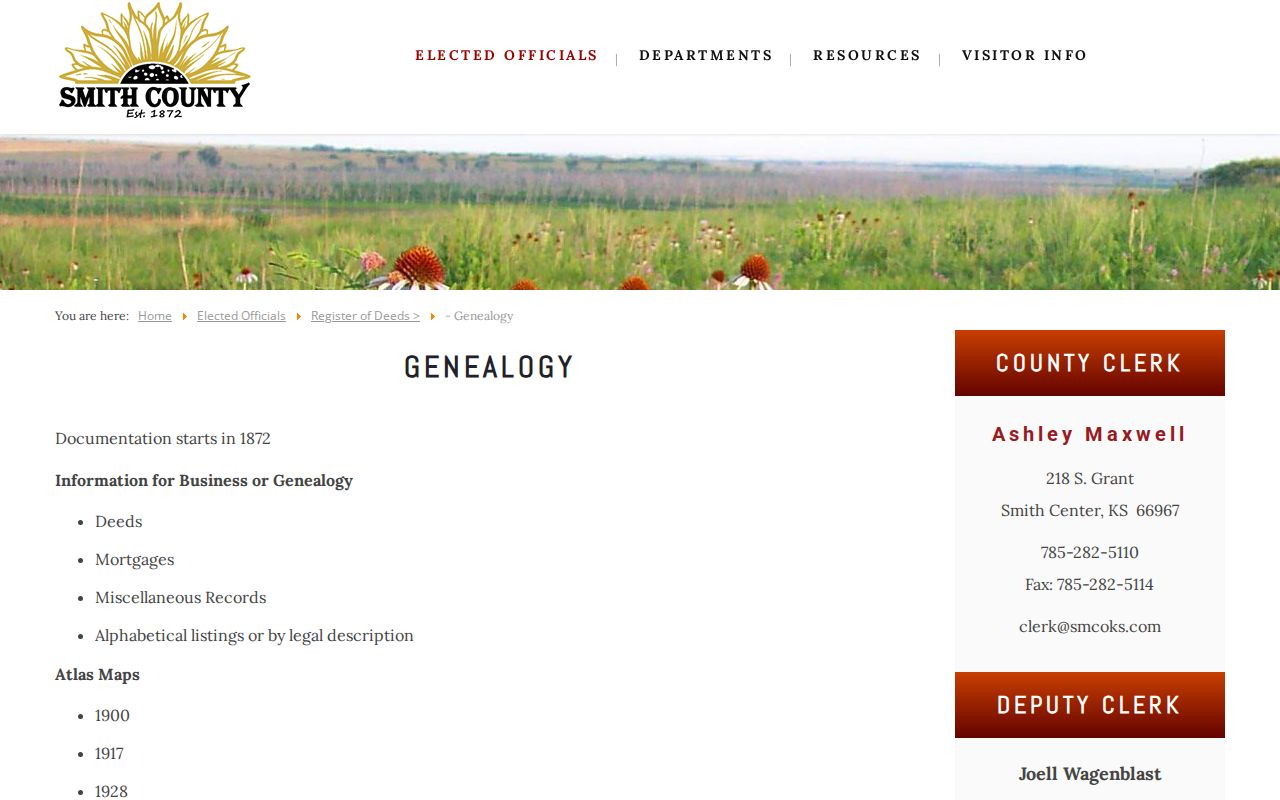
The county's own list opens a sound route into older Smith County deed records. School-district records from 1913 through 1964 and 1989 cemetery books add helpful context, though neither one replaces a deed chain.
Online gap. Smith County documents begin in 1872, but no public online deed index was found. Older and current searches may require the office or deed books.
Cedarville and Smith Center Deeds
The 1872 county-seat fight between Cedarville and Smith Center is more than trivia. An old deed, notice, or directory may carry a historic community name. But a modern tax record uses a different label. Search both. Hold the legal description steady as the constant.
Kansas Memory's 1900 Smith County plat book adds township landowners, a patrons' directory, and town plats. The town plats cover Smith Center, Cedarville, Kensington, Lebanon, Reamsville, and other places. It is a map snapshot rather than title proof. Yet it can tie an old name to the right township or plat.
For rural land, work the atlas first. Recover the township, section, nearby place, or owner spelling. Then move into the county deed books. Kansas is a public-domain land state. So the first federal transfer may appear only in tract books organized by legal description rather than by name. A Bureau of Land Management patent can supply the first grantee and land description. Later private transfers stay in the Smith County recording chain.
Town property needs a different key. Save the addition, block, lot, and any street or alley reference. The historic atlas may show the town grid. But a later recorded plat, replat, vacation, or deed can change what the record says. The old map gives context; the recorded instrument supplies the legal evidence for that date.
Get a Smith County Deed Copy
Smith County publishes no public image viewer for deed records. Request a copy at the counter, by phone, or by email. You can also file a focused Kansas Open Records Act request. Give the recording reference when you have it. Without one, supply party names, a date range, the legal description, and the parcel key. Say whether a plain copy will do or certification is required.
KORA obliges an agency to act by the close of the third business day. It does not promise that a broad, old, or redacted file will be ready by then. Smith County may bill actual search time. Ask for an estimate before authorizing a large pull.
A plain copy suits reading and research when no agency or transaction demands certification. A certified instrument carries the recorder's certification and costs more. Smith County posts plain copies at $1 per page and a certified instrument at $13. Recording a new document is a separate service with its own fee schedule and legal requirements. Paying a recording fee never proves an instrument conveys clear title.
Put any written request in order. Name the Register of Deeds as custodian, describe the instrument or tract, and state the date span. Ask for paper or electronic delivery. The county genealogy page posts separate open-record copy and research charges. Those charges include staff time for broad work. Request an estimate. Ask whether an in-person index search can narrow the pull before copies are made.
Recorded, not guaranteed. Smith County deed records show accepted instruments. They are not a title opinion and cannot rule out unrecorded interests or indexing gaps.