
Smith County Tax Record Fields
Smith County splits its parcel facts between two offices. The appraisal record holds owner and situs information, building characteristics, land use, valuation history, and agricultural or soil data. The tax statement shows the tax type, year, amount, and payment state. Read the two records side by side. Neither one substitutes for the other.
| Field | What It Shows | Where |
|---|---|---|
| Appraised value | County estimate of market value for assessment | Smith County Appraiser |
| Assessed value | Appraised value multiplied by the statutory class ratio | Smith County Appraiser |
| Land and improvements | Separate components used in the parcel valuation | Smith County Appraiser |
| Tax statement and status | Tax year, amount, payment, and current or delinquent state | Smith County Treasurer |
| CAMA and tax ID | Distinct county keys used to retrieve the holding and statement | Appraiser and Treasurer systems |
A recorded sale price is evidence of a transaction, not an automatic new value. Kansas first applies an assessment percentage to the appraised value. The mill levy then applies to that assessed value. Local charges can round out the final bill. This sequence explains why sale price, appraised value, assessed value, and tax due rarely match.
Start Smith County Tax Searches Correctly
The county Tax Search starts with tax type. Real Estate carries the RL label. The form also covers Personal Property, Oil, Gas, Trucks, Minerals, and State Assessed Utilities. A name alone can land in the wrong class. So choose RL before treating a result as land or a house.
One checkbox narrows results to statements with taxes due, current or delinquent. That filter is handy but is not a sale notice. Record the tax year, tax type, status, CAMA number, tax ID, and legal description. Take these from every result. The portal posts its database update date. The listed update came on August 22, 2026. Treat that as a freshness marker, not proof that every later event has posted.
| Search control | Use | Practical check |
|---|---|---|
| Tax Type | Separates real estate from six other classes | Select RL for land and buildings |
| Name Role | Current Owner, Taxpayer, or Both | Run roles separately when names differ |
| Street Number / Name | Starts with the situs address | Try full and abbreviated street forms |
| Subdivision / Block / Lot | Narrows platted town property | Match the recorded plat name |
| Section / Township / Range | Narrows rural land | Keep each legal-description part |
| Taxes Due | Filters current or delinquent statements | Confirm year and payment with Treasurer |
Smith County Assessed Value Math
For residential property, Kansas generally applies an assessment percentage of 11.5 percent. The rule comes from K.S.A. 79-1439. Multiply appraised value by the class ratio. That gives you the assessed value. Then multiply assessed value by the mill levy to estimate tax. Other property classes may use a different percentage than the residential one.
- Appraised value
- The county's estimate of market value for the parcel.
- Assessed value
- The amount produced after applying the statutory class ratio.
- Mill levy
- The tax rate applied to assessed value, expressed in mills.
- Tax lien
- A claim tied to unpaid tax; status and later action require official confirmation.
The fuller distinction between these numbers lives on the Smith County property value page. Here, use property tax records to follow an assessment into a bill, a payment state, or an appeal route.
Smith County's 2026 Value Notice
The Smith County Appraiser's real-property notice reported a general upward trend in 2026. The trend covered residential, commercial, and vacant categories. Individual parcels can still move differently because of corrections, property changes, characteristics, and market conditions. A countywide trend is not a city median. It predicts nothing about one parcel.
Compare the parcel's own value history, land and improvement components, class, and any sale reference. Appraiser staff run a six-year inspection program and photograph houses and outbuildings. They generally inspect from June through October. A changed building characteristic can shift value even when the broad notice sounds similar to last year's.
The county's Appraiser FAQ supplies the official context for valuation methods and review questions.
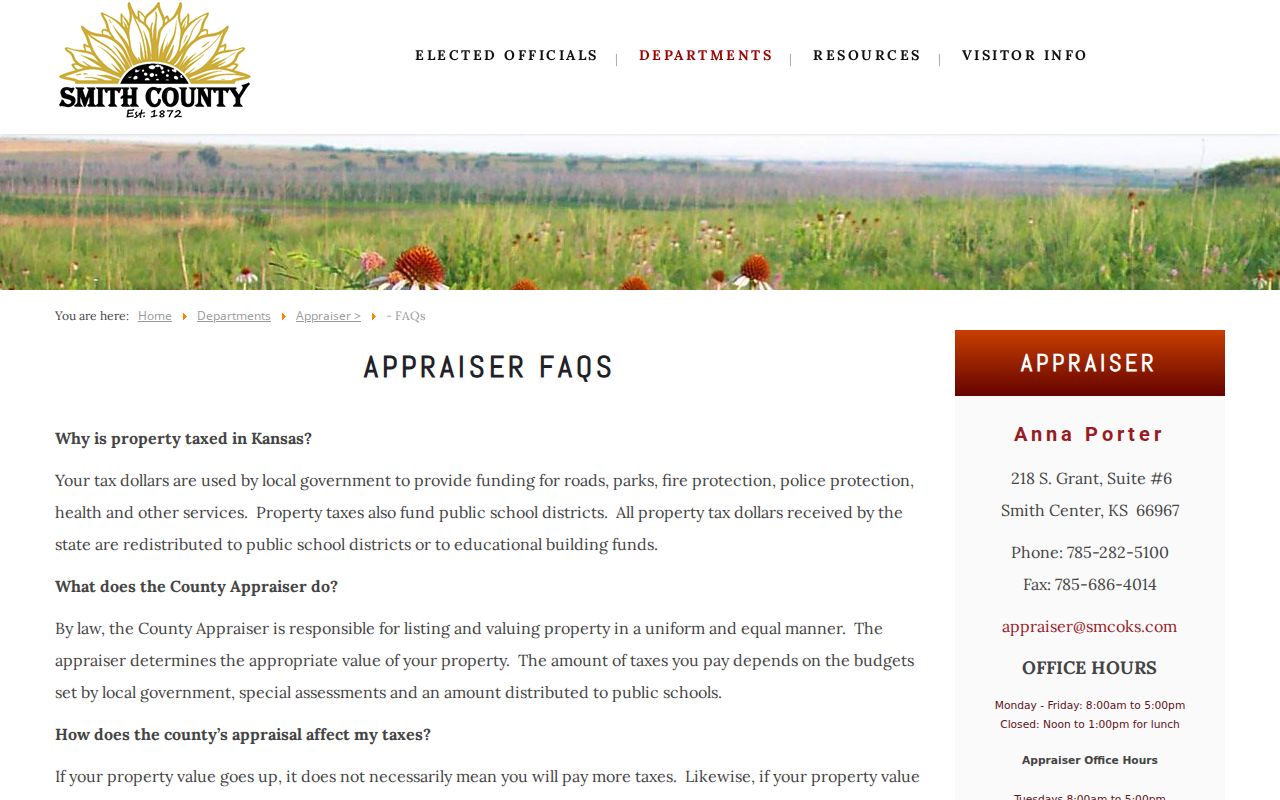
The Appraiser's notice page helps in a specific way. It separates a value question from a Treasurer bill or payment question.
The notice also explains why a county trend cannot settle an individual appeal. Corrections, new improvements, property characteristics, and verified market evidence can pull one parcel away from its category. Set the parcel's current record beside its prior value history and change notice. Keep land and improvement components separate. If an inspection changed a building fact, ask a focused question. Which characteristic changed, and when did it enter the roll? That focused question beats treating the general upward trend as your parcel's result.
Note: Record the tax year and database update date beside every value copied from the portal.
Look Up Smith County Tax Bills
A Smith County property tax search works best when each identifier travels with you. The CAMA number uses segmented fields and reaches a holding directly. The tax ID is a separate number. The legal description remains the durable land key. It matches a tax record to deeds and plats.
- Select Real Estate in Tax Search, then enter a street number and street name or an exact county identifier.
- Open the likely result and copy its tax year, CAMA number, tax ID, legal description, owner role, and situs address.
- Read the statement status and amount. Run Current Owner and Taxpayer separately if the displayed names differ.
- Compare the parcel through the Appraiser public-record route, then ask the Treasurer to confirm any due or delinquent status.
The Treasurer sits in Suite 4 at 218 S. Grant, Smith Center. Call 785-282-5170 or email sctreasurer@ruraltel.net. Main-office hours run 8 a.m. to 4 p.m. on Monday and Wednesday through Friday, with Tuesday hours of 7 a.m. to 4 p.m. The office stays open through lunch.
Smith County Delinquent Tax Trail
An unpaid balance does not guarantee a sale. Kansas county treasurer guidance sends delinquent real-estate taxes to foreclosure once they sit unpaid for three years. Each August, the county newspaper publishes current delinquent real-estate taxes for three consecutive weeks. That notice runs under K.S.A. 79-2301 through 79-2323a. The county does not post its publication title or current sale schedule online.
Confirm the tax type, installment, year, and payment. Then trace the foreclosure referral and any redemption. For a serious delinquency question, ask the Treasurer for the current status, search Kansas CaseSearch for a court case, and ask the Register of Deeds about notices, sheriff's deeds, redemptions, or releases. A portal checkbox is only the first lead. Keep copies of every notice you receive.
Verify before acting. Fake tax-sale notices exist; match the taxpayer, tax ID, year, and case number with official custodians.
Smith County Tax Access Channels
Online tools are only one route. Smith County also handles requests in person, by phone, by email, and in writing. If the Tax Search fails, contact the Treasurer. Keep the request narrow. For valuation records, the Appraiser provides most ordinary copies the same day, and research, large copying, or computer and storage work is expected within three working days.
A Kansas Open Records Act request works best when specific. Name the parcel, the tax year, the record title, and the office you believe holds it. Smith County posts its general KORA copy charges. Letter and legal pages cost $0.25 each. Oversize pages cost $0.50. Research time runs $20 per hour or a higher actual employee rate. Under K.S.A. 45-218, the office must act by the close of the third business day, though that does not guarantee final production.
Visit the courthouse counter when an online result is unclear. A written request suits a particular statement, value-history entry, or parcel file, not an open-ended demand for everything tied to a name. Narrow requests cost less.
Phone and email requests need the same precise keys. State whether the question concerns valuation, a tax statement, payment status, or a delinquent balance so it reaches the Appraiser or the Treasurer. Before ordering copies, ask for the record's tax year, update date, fee, and delivery method, and for an older entry ask whether the file sits in the active system or must be retrieved from storage.
Smith County Revitalization Records
Smith County's Neighborhood Revitalization Plan runs from 2022 through 2027. Qualifying improvements create their own property tax record trail. The plan offers a rebate tied to increased value. There is also a $200 application fee. Smith Center Ordinance 1039 backs the local plan, so a project inside Smith Center may touch both city and county records.
Do not assume participation from a permit or a value jump, since a city permit covers a municipal step only. Ask the Appraiser for the plan materials, application status, base value, added value, and the tax years that apply. The county file documents the appraisal and rebate administration.
Contest a Smith County Assessment
Smith County mails change-of-value notices on or before March 1 each year. You then have 30 days to contact the Appraiser. A separate payment-protest route comes later. December 20 is the regular payment point. An escrow-paid taxpayer can use the January 31 path described in Kansas treasurer guidance. The notice itself controls the applicable deadline.
Good evidence is parcel-specific. Bring the record card, land and improvement values, building characteristics, recent comparable sales, photographs, and proof of an error in use, size, condition, or class. A broad claim that the market dropped is weaker than facts tied to the parcel. Contact the Appraiser promptly, and keep the notice date and your submission receipt.
Appeal window. Contact the Smith County Appraiser within 30 days of the value notice; tax-payment protests use their own statutory calendar.